Google Unveils a Reimagined Gemini Deep Research Agent Powered by Gemini 3 Pro
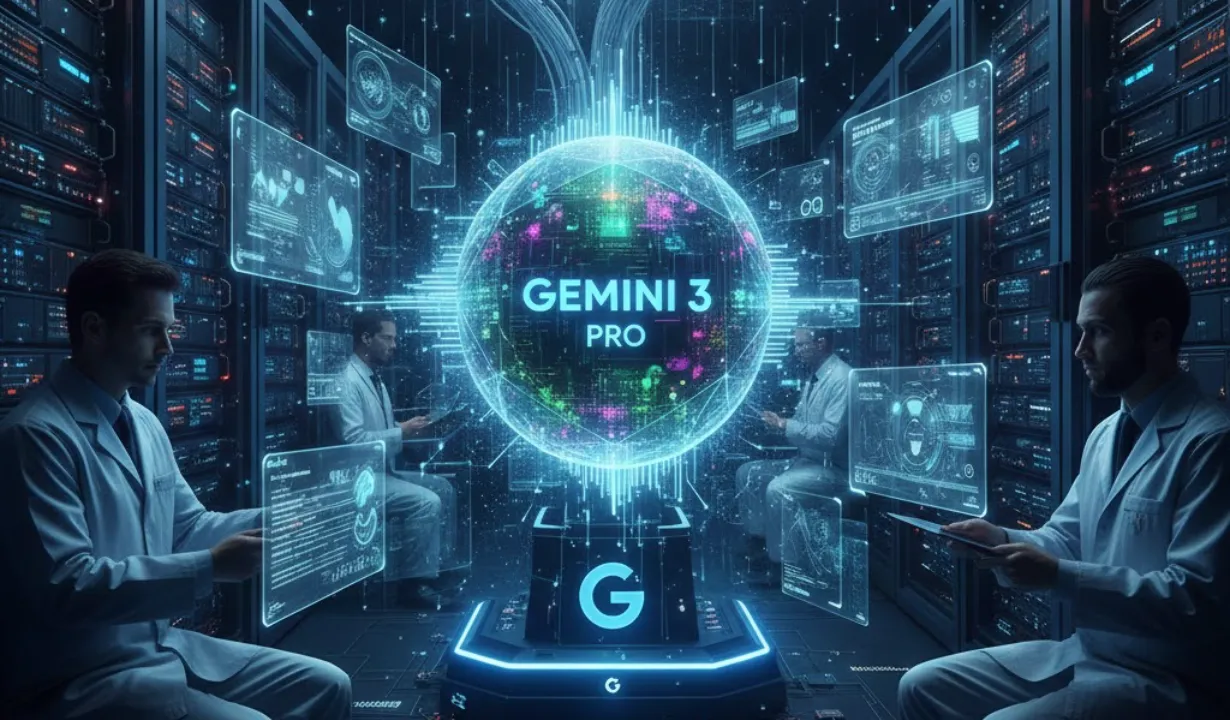
Gemini 3 Pro: Google on Thursday rolled out a significantly upgraded version of its research assistant, Gemini Deep Research, now rebuilt on top of the company’s flagship foundation model Gemini 3 Pro.
This refreshed agent does far more than generate research reports. For the first time, Google is allowing developers to embed its advanced research capabilities directly into their own applications, thanks to a new Interactions API that offers deeper control and flexibility — a move geared toward the fast-approaching era of autonomous AI agents.
A More Capable Research Agent
The upgraded Gemini Deep Research tool is engineered to analyze massive volumes of information and process extremely large context inputs. According to Google, customers already rely on it for demanding tasks such as due-diligence investigations and drug toxicity evaluations.
Google plans to integrate this new agent across its ecosystem very soon, including Google Search, Google Finance, the Gemini app, and NotebookLM. It’s part of a broader shift toward a future where users no longer perform searches themselves — their AI agents do the heavy lifting.
Gemini 3 Pro Enhances Accuracy
A major selling point of Deep Research is its improved factual reliability. Google claims Gemini 3 Pro is its “most factual” model to date, trained specifically to minimize AI hallucinations, which are especially problematic during long, multi-step reasoning tasks. In such processes, one incorrect decision can ruin the entire output.
New Benchmark: DeepSearchQA
To support its claims, Google released a new benchmark called DeepSearchQA, built to measure performance on complex, multi-step information-retrieval challenges. The benchmark is open sourced.
Google also tested the agent against two well-known external tasks:
- Humanity’s Last Exam — a notoriously difficult general knowledge benchmark
- BrowserComp — which evaluates performance on browser-based agentic tasks
Google reported that Gemini Deep Research topped the charts on its own benchmark and on Humanity’s Last Exam. However, OpenAI’s ChatGPT 5 Pro trailed closely behind — and even outperformed Google on BrowserComp.
OpenAI Responds With GPT 5.2 “Garlic”
But Google’s victory lap was short-lived. On the same day, OpenAI launched GPT 5.2, internally codenamed Garlic, claiming significant improvements over rivals — particularly Google — across a wide range of benchmarks, including its proprietary suite.
Strategic Timing
The timing of Google’s announcement is notable. With the tech world awaiting OpenAI’s next big release, Google appears to have strategically published its own updates to stay in the spotlight.
Also read;
WhatsApp Is Finally Adding WhatsApp Status Drafts — Here’s How the New Feature Works
OPPO K13 Turbo 5G at Just ₹11,499 — This Might Be the Real Flagship Killer of 2025








Post Comment