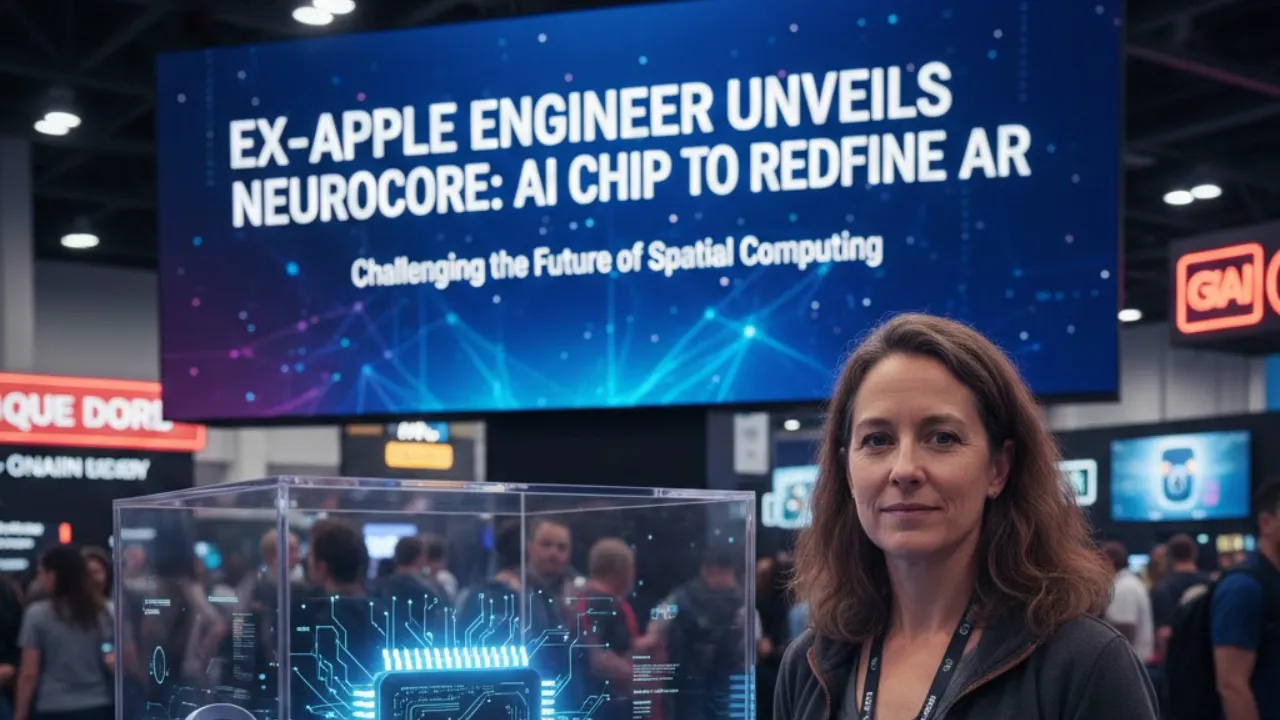

A Chinese startup founded by former Apple engineer Wang Chaohao is grabbing global attention after showcasing an advanced AI smart-glasses chip that could challenge some of Apple’s most premium devices. Wang, who previously worked in Apple’s extended reality (XR) division, now leads GravityXR, a fast-growing company in China that aims to build high-end components for the next generation of AI and mixed-reality hardware.
With China pushing for technological independence and companies racing to dominate the future of spatial computing, GravityXR’s ambitions are drawing major interest.
What Is GravityXR’s AI Chip?
GravityXR recently unveiled its latest breakthrough — the Jizhi G-X100, billed as China’s first all-in-one mixed reality chip built using advanced 5nm technology.
The chip is designed specifically for lightweight AI glasses and XR headsets, placing it in direct competition with the kind of high-performance hardware that powers Apple’s Vision Pro, one of the most sophisticated mixed-reality headsets available today.
GravityXR says the G-X100 is engineered for the next stage of wearable computing, combining AI processing, graphics performance, and sensor integration into a single highly efficient unit. Because it uses cutting-edge 5nm architecture, the chip promises better speed, lower power consumption, and more compact physical design — all crucial for devices worn on the head or face.
Is It Better Than Apple’s Tech?
One of the most surprising claims from GravityXR revolves around latency, a key factor in delivering smooth and natural mixed-reality experiences.
The G-X100 chip has a photon-to-photon latency of just 9 milliseconds, which the company says is faster than the 12 milliseconds achieved by the Apple Vision Pro headset.
If accurate, this means that devices powered by GravityXR’s chip could potentially feel more responsive, more stable, and closer to real-world motion — which is critical in XR environments, where any lag can cause discomfort or break immersion.
Low latency is especially important for:
- Virtual reality
- Augmented reality
- Spatial computing
- AI-driven glasses
- Mixed-reality headsets
In all these segments, reducing the delay between user movement and on-screen output makes the experience far more realistic.
GravityXR says the chip can support everything from small, everyday AI glasses to high-end, fully immersive XR devices. By improving the connection between the physical and digital worlds, the G-X100 aims to advance the broader field of spatial computing, where digital objects blend seamlessly into real-world surroundings.
Why Wang Chaohao’s Move Matters
Wang Chaohao’s departure from Apple and his decision to found a startup in China highlight a major shift in the global tech landscape. His background — working inside Apple’s XR team and studying at Stanford University — adds significant credibility to his company’s vision.
His journey also reflects a deeper trend: as tensions between the US and China continue — especially over advanced chips and AI technologies — more Chinese companies are investing heavily to create domestic alternatives to American hardware.
The Chinese government and local investors have been encouraging innovation in fields such as:
- AI processors
- XR hardware
- Semiconductors
- Optical systems
- Wearable devices
GravityXR fits directly into this push, positioning itself to reduce China’s dependence on foreign technology while competing globally.
Major Investors Already Backing the Startup
GravityXR’s ambitions are not going unnoticed. The company has already secured investments from several major names in China’s tech ecosystem, including:
- HongShan (formerly Sequoia Capital China)
- Gaorong Capital
- Goertek, a giant in electronics manufacturing
- miHoYo, the famous video-game studio behind Genshin Impact
Support from these investors signals confidence not only in the G-X100 chip but also in the future of XR and AI wearables within China.
Goertek’s involvement is especially notable because the company is one of the world’s biggest manufacturers of VR and AR hardware components. Meanwhile, miHoYo’s interest hints at the importance of XR technology for future gaming experiences.
A Rising Challenger in Mixed Reality
With the debut of the Jizhi G-X100, GravityXR is positioning itself as a serious challenger to tech giants like Apple in the fast-expanding mixed-reality market. While Apple’s Vision Pro continues to dominate the premium XR segment, GravityXR is emerging as a strong local competitor at a time when next-generation chips and AI capabilities are becoming central to future devices.
If GravityXR can deliver on its promises — faster performance, lower latency, and compact design — the global XR landscape may soon see a major shake-up.
Also read;
7 Smart Ways to Improve Battery Life on Your Samsung Galaxy Phone
Apple Reveals the 2025 Apple App Store Award Winners — You’ll Be Surprised Which Apps Made the List
WhatsApp Just Got a Massive AI Upgrade — Imagine Tools Are Now Coming to WhatsApp Status Updates!